Banjo Head Adjustment - "G" For Me, Please
WARNING! This post is sort of banjo techy, but I think you should read it anyway.
 Like most banjo players, I like to tinker with my banjo from time to time. When I say tinker, I'm not talking about playing it as a musical instrument; I'm talking about making various adjustments on it to see how it will react to whatever changes I've made. There are also times when I'll make adjustments that are not for the purpose of tinkering; these adjustments are required as part of the normal care and feeding (aka maintenance) of a banjo.
It would appear some people think if you need to make adjustments a few times each year, you must have a lemon for an instrument, but nothing could be further from the truth. Whether you pay a hundred dollars or ten thousand dollars for your banjo, you'll need to make frequent adjustments.
There are many factors that can affect the tone of your banjo - all instruments actually, but it seems the banjo is very adept at letting you know when it isn't in tip-top form. This is partly due to the tonal range of a banjo and the characteristic ringing that banjos produce; anything too far out of whack quickly shows up in your ear.
Probably the single biggest item that can affect the tone of a banjo is the tightness of the head. As luck would have it, head tightness is also one of the items that changes most often. This means frequent adjustments are required. When I say frequent, I'm talking anywhere from 2 to 4 times a year. I think that would be considered frequent if you compared how often most people make adjustments to their guitars.
Why does the head tightness keep changing? I think there are two main reasons for this. The main reason for the change in head tightness would be from changes in the humidity level. During the winter season in my neck of the woods, the air is dry; and even dryer indoors because of the drying effect of heating my home. If you're in an area with these conditions, the lack of moisture will eventually show up as a change in tone to your banjo as the wood rim shrinks. The tone will probably be more "tubby" sounding. As the rim shrinks, the hooks that apply pressure between the tension hoop and the flange become too long because the rim isn't as high as it used to be. This results in the head having less tension. You might even notice the action on the banjo becoming a bit lower due to less "up pressure" on the bridge as it more readily sags into the head.
The opposite is true in the summer months (in my neck of the woods). The summer months are humid, which allows the rim to take on more moisture. The banjo may become more "tinny" sounding as the head becomes tighter. The head becomes tighter because the rim is swelling and the hooks now need to be longer if the same tension is to be applied, that once was.
I've just described how the head can become tighter in the summer months, but it can also become loose in the summer. I know, this sounds like some type of contradiction, but it's not. The banjo vibrates a great deal and this can cause the nuts on the hooks to back off. If the nuts back off more than the amount required to compensate for the extra moisture, you'll witness a loose head.
The answer to all of this is simply to check the tone of the banjo frequently; I suggest at least once a month. Tap the head to determine which note the pot assembly resonates at. Is it the same as it was the last time you checked? Also, try playing the banjo up the neck. Are the notes ringing out loud and clear all over the neck? They should be.
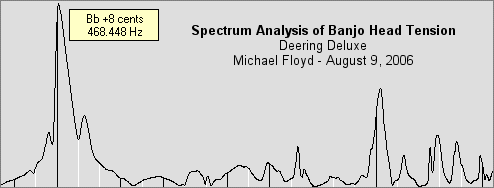
I've talked about tightening banjo heads in previous posts and even performed a small audio spectrum analysis on my Deering Deluxe banjo. In those posts I talk about how to "tune" the head to a certain note, which I learned how to do from Steve Huber of Huber Banjos. You can read those articles (August 9 and 12, 2006) here if you wish.
Aapparently (read from what I've been told) there are those that argue whether I am able to tune the head of a banjo using the head tapping technique; that there is no way I can hear the note to which the head is tuned. For the record, I don't claim to have invented the idea of tap-tuning, but I can also tell you I'm not making this stuff up. I learned the technique from Steve Huber's Killer Tone DVD. I've also seen a Morris Music employee tune a set of drums this way; he matched each drum in a set of four to the notes on a bass guitar. I doubt anyone even remotely familiar with banjos would dispute what Steve Huber says about the topic, but I could be wrong about that too.
Somebody said "you should have your hearing checked" ... so I did. That's right, I actually had a hearing test performed this past Monday at AudioCorp in Saint John, NB and I'm happy to report that both of my ears are still in the normal range of hearing. I want to keep it that way, so I'll be practicing with ear plugs from now on.
My most recent head adjustment (banjo head, that is - if I were talking about the head on my shoulders it would be more of an attitude adjustment) was performed a couple nights ago and that was to correct a mistake I made while tightening it just a few weeks back. Yes people, I made a mistake! About 3 weeks ago I noticed the banjo just wasn't up to par; just not sounding as good as it should. The resonant frequency of the head and pot assembly had slipped all the way down to an "F" note; I normally keep it tuned to a "G" note.
While the banjo sounded "okay" in open G tuning, it really lacked brightness and sustain up the neck. I decided I couldn't take it any longer and began to make adjustments. I inadvertently tuned the head to a "G#" note, but decided to leave it there for a while to see if I liked it. I thought it was okay, but still lacking something, so I took it back to a "G" note and now I'm happy with it again.
It is my belief that you cannot buy a banjo, have it tuned by a pro and then walk away from it, expecting it to sound great for the rest of its life; you WILL need to make adjustments if you want to keep it sounding optimal. Having your banjo tuned by a luthier up to four times a year may or may not be something you are willing to pay for. If you're opposed to paying for this service, the tone of your banjo will probably suffer; that's why every banjo player should know how to do it for themselves. To learn how to tune your banjo head and keep it in tip-top shape, I recommend highly Steve Huber's DVD called Killer Tone, available from Huber Banjos.
In the image at the top of this post, you will see the tools I use for tightening a banjo head. These tools consist of a tuner for tuning the banjo strings (Peterson Strobo-Flip tuner shown but could be any tuner), a Tee wrench for tightening the nuts on the tension hooks, and a drum torque wrench for getting even tightness all the way 'round the head. I used to tighten the head by "feel" without a torque wrench; after using the torque wrench however, I'd never do another head tightening without one.
Click on the image to see a larger version of the same.
 Like most banjo players, I like to tinker with my banjo from time to time. When I say tinker, I'm not talking about playing it as a musical instrument; I'm talking about making various adjustments on it to see how it will react to whatever changes I've made. There are also times when I'll make adjustments that are not for the purpose of tinkering; these adjustments are required as part of the normal care and feeding (aka maintenance) of a banjo.
It would appear some people think if you need to make adjustments a few times each year, you must have a lemon for an instrument, but nothing could be further from the truth. Whether you pay a hundred dollars or ten thousand dollars for your banjo, you'll need to make frequent adjustments.
There are many factors that can affect the tone of your banjo - all instruments actually, but it seems the banjo is very adept at letting you know when it isn't in tip-top form. This is partly due to the tonal range of a banjo and the characteristic ringing that banjos produce; anything too far out of whack quickly shows up in your ear.
Probably the single biggest item that can affect the tone of a banjo is the tightness of the head. As luck would have it, head tightness is also one of the items that changes most often. This means frequent adjustments are required. When I say frequent, I'm talking anywhere from 2 to 4 times a year. I think that would be considered frequent if you compared how often most people make adjustments to their guitars.
Why does the head tightness keep changing? I think there are two main reasons for this. The main reason for the change in head tightness would be from changes in the humidity level. During the winter season in my neck of the woods, the air is dry; and even dryer indoors because of the drying effect of heating my home. If you're in an area with these conditions, the lack of moisture will eventually show up as a change in tone to your banjo as the wood rim shrinks. The tone will probably be more "tubby" sounding. As the rim shrinks, the hooks that apply pressure between the tension hoop and the flange become too long because the rim isn't as high as it used to be. This results in the head having less tension. You might even notice the action on the banjo becoming a bit lower due to less "up pressure" on the bridge as it more readily sags into the head.
The opposite is true in the summer months (in my neck of the woods). The summer months are humid, which allows the rim to take on more moisture. The banjo may become more "tinny" sounding as the head becomes tighter. The head becomes tighter because the rim is swelling and the hooks now need to be longer if the same tension is to be applied, that once was.
I've just described how the head can become tighter in the summer months, but it can also become loose in the summer. I know, this sounds like some type of contradiction, but it's not. The banjo vibrates a great deal and this can cause the nuts on the hooks to back off. If the nuts back off more than the amount required to compensate for the extra moisture, you'll witness a loose head.
The answer to all of this is simply to check the tone of the banjo frequently; I suggest at least once a month. Tap the head to determine which note the pot assembly resonates at. Is it the same as it was the last time you checked? Also, try playing the banjo up the neck. Are the notes ringing out loud and clear all over the neck? They should be.
I've talked about tightening banjo heads in previous posts and even performed a small audio spectrum analysis on my Deering Deluxe banjo. In those posts I talk about how to "tune" the head to a certain note, which I learned how to do from Steve Huber of Huber Banjos. You can read those articles (August 9 and 12, 2006) here if you wish.
Aapparently (read from what I've been told) there are those that argue whether I am able to tune the head of a banjo using the head tapping technique; that there is no way I can hear the note to which the head is tuned. For the record, I don't claim to have invented the idea of tap-tuning, but I can also tell you I'm not making this stuff up. I learned the technique from Steve Huber's Killer Tone DVD. I've also seen a Morris Music employee tune a set of drums this way; he matched each drum in a set of four to the notes on a bass guitar. I doubt anyone even remotely familiar with banjos would dispute what Steve Huber says about the topic, but I could be wrong about that too.
Somebody said "you should have your hearing checked" ... so I did. That's right, I actually had a hearing test performed this past Monday at AudioCorp in Saint John, NB and I'm happy to report that both of my ears are still in the normal range of hearing. I want to keep it that way, so I'll be practicing with ear plugs from now on.
My most recent head adjustment (banjo head, that is - if I were talking about the head on my shoulders it would be more of an attitude adjustment) was performed a couple nights ago and that was to correct a mistake I made while tightening it just a few weeks back. Yes people, I made a mistake! About 3 weeks ago I noticed the banjo just wasn't up to par; just not sounding as good as it should. The resonant frequency of the head and pot assembly had slipped all the way down to an "F" note; I normally keep it tuned to a "G" note.
| Somebody said "you should get your hearing checked" ... so I did. |
While the banjo sounded "okay" in open G tuning, it really lacked brightness and sustain up the neck. I decided I couldn't take it any longer and began to make adjustments. I inadvertently tuned the head to a "G#" note, but decided to leave it there for a while to see if I liked it. I thought it was okay, but still lacking something, so I took it back to a "G" note and now I'm happy with it again.
It is my belief that you cannot buy a banjo, have it tuned by a pro and then walk away from it, expecting it to sound great for the rest of its life; you WILL need to make adjustments if you want to keep it sounding optimal. Having your banjo tuned by a luthier up to four times a year may or may not be something you are willing to pay for. If you're opposed to paying for this service, the tone of your banjo will probably suffer; that's why every banjo player should know how to do it for themselves. To learn how to tune your banjo head and keep it in tip-top shape, I recommend highly Steve Huber's DVD called Killer Tone, available from Huber Banjos.
In the image at the top of this post, you will see the tools I use for tightening a banjo head. These tools consist of a tuner for tuning the banjo strings (Peterson Strobo-Flip tuner shown but could be any tuner), a Tee wrench for tightening the nuts on the tension hooks, and a drum torque wrench for getting even tightness all the way 'round the head. I used to tighten the head by "feel" without a torque wrench; after using the torque wrench however, I'd never do another head tightening without one.
Click on the image to see a larger version of the same.
Labels: banjo, head tightness, hearing test, tuning head
posted by Michael Floyd at 9:20 PM
4 comments